



How to check a used car's history, inspect it with the engine cold, and read the seller, so you do not get stuck with a lemon in Queensland.
How Do You Avoid Buying a Lemon Car?
You avoid buying a lemon by checking the car's history, inspecting it properly with the engine cold, and refusing to be hurried into a decision. Most lemons give themselves away before you pay. The price is too good, the seller is cagey about the paperwork, the engine sounds off on a cold start, or the story does not add up. None of that needs a mechanic's eye to spot. It just needs you to slow down and look.
The one thing worth knowing up front is that a roadworthy certificate is not a health check. It confirms the car met Queensland's minimum safety standard on the day it was inspected, and nothing more. A car can hold a valid safety certificate and still hide a tired gearbox or a patched-up crash repair. For what that certificate does and does not cover, see our guide to the QLD roadworthy certificate. The two checks that actually protect you are a history report on the VIN and an independent mechanic, not the seller's word.
What Are the 8 Red Flags of a Lemon Car?
There are eight red flags that come up again and again. Any one of them is a reason to ask more questions. Two or more together and you are usually better off walking to a different car.
| Red flag | What to check | Why it matters |
|---|---|---|
| Price too low | Compare against similar cars for age and kilometres | A car priced well under market often has a problem the seller already knows about |
| Sketchy history | Finance owing, write-off status, owner changes, rego gaps | You can inherit someone else's debt or a repaired crash car |
| Engine noises | Ticking, rattling, or piston slap on a cold start | Cold-start noise points to internal wear that a warm engine hides |
| Suspect paintwork | Panel gaps, colour mismatch, overspray, body filler | Signs of a past collision or hidden structural repair |
| Odometer tampering | Interior wear against the reading, gaps in the service stamps | A digital odometer can be wound back in under twenty minutes |
| Electrical faults | Warning lights that flicker on then vanish, dead accessories | Electrical gremlins are expensive to trace and rarely come alone |
| Shady seller | Multiple phone numbers, no fixed address, car park meetings | Unlicensed traders leave you no comeback when it goes wrong |
| VIN mismatch | The VIN reading the same in every location on the car | Mismatched VINs can mean a stolen or rebirthed vehicle |
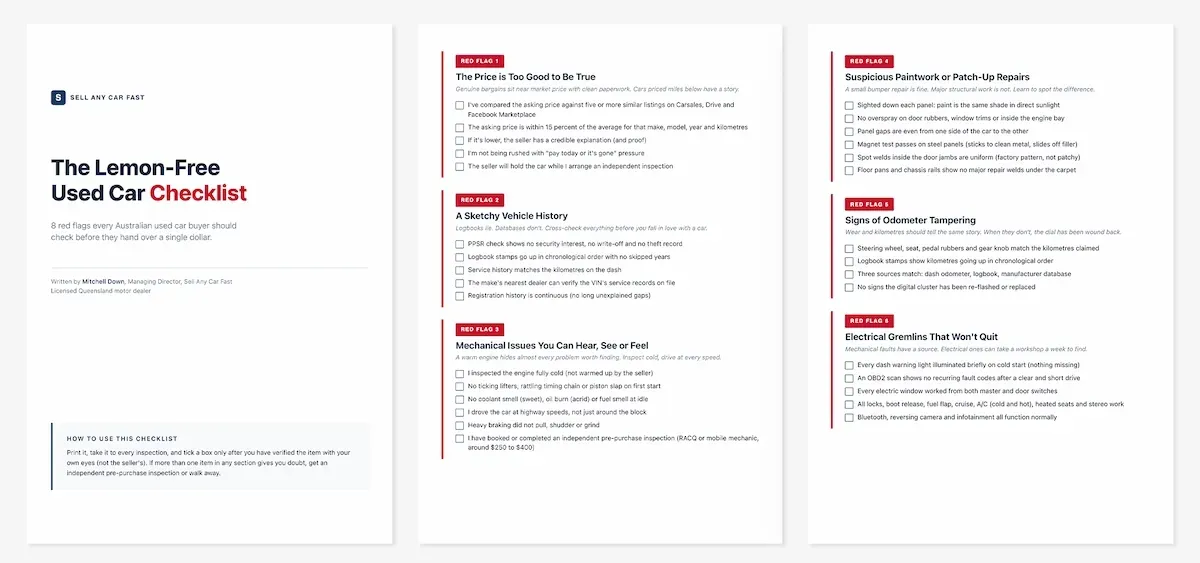
The rest of this guide takes the flags worth explaining and shows you how to actually check them. If you would rather run through them on the day with a sheet in your hand, we keep a free used car buying checklist you can print and take along.
Why Is a Price That Looks Too Good a Warning Sign?
A price well under the market usually has a story behind it. Sellers drop the price to move a car quickly, often before a fault becomes obvious to them or gets picked up in a history report. A genuine bargain tends to sit close to market with clean paperwork behind it. A car priced to disappear is the one to question.
To sanity-check a price, compare the same make, model, year, and kilometres across Carsales, Drive, and Facebook Marketplace, and work out a rough average. If the car in front of you is more than 15 to 20 percent below that, treat the gap as a question the seller needs to answer, not a win. If the asking price looks suspiciously low, cross-check it against a real market figure with a car valuation tool before you assume you have found a deal.
Watch the pressure that tends to come with an underpriced car. "Pay today or it is gone by lunchtime" and "another buyer is on their way over" are lines designed to stop you thinking. A seller with an honest car wants the right buyer, not the fastest one, because a rushed sale is where disputes start. If someone is pushing you to skip the checks, that is usually the reason to do them.
How Do You Check a Used Car's History Before You Buy?
Run a history check on the VIN before you inspect the car, not after. A PPSR report is the official Australian register, and a clean one shows no money owing against the car, no write-off record, and no theft record. Anything less than that means you could inherit someone else's debt or a repaired write-off. The full VIN and PPSR check, and how to read the report, is covered on our VIN check QLD page.
The single most important item is finance. If there is money still owing on the car, that debt follows the vehicle and not the seller, so the lender can repossess it after you have paid. It happens often enough to be worth its own read: see buying or selling a car with finance owing. The other history flags worth walking away from are an undisclosed repairable write-off, several owners in a short stretch (especially across state lines), and gaps in the registration that suggest months sitting off the road. A repairable write-off is legal to sell in Queensland once it has passed re-inspection, but it must be disclosed and it is worth less. You can read what the categories mean on our Queensland written-off vehicle register guide.
Cross-check the service history rather than trusting the book on its own. A logbook can be filled in by anyone, but a manufacturer's dealer database cannot be forged. Ring the nearest dealer for that make, give them the VIN, and ask them to confirm the official service record. A full-looking logbook that the dealer has no record of is a forged one, and that tells you plenty about the rest of the car.
What Mechanical Signs Should You Check?
Inspect the car in daylight, on a dry day, with the engine stone cold. Bright light shows paint and panel work that a dim garage hides, and a cold engine tells you far more than one the seller has already run up to temperature for you. Give yourself half an hour and do not let anyone hurry you through it.
Sounds and Smells on a Cold Start
Start the car cold and listen before you touch anything else. Ticking lifters, a rattling timing chain, or a heavy piston slap that fades after the first thirty seconds all point to internal wear. Use your nose too. A sweet smell is coolant, a sharp oily smell is burning oil, and either one means money. Blue or white smoke from the exhaust past the first few seconds backs that up. A healthy engine catches cleanly, settles into a smooth idle, and does not keep smoking. Check that every warning light comes on with the ignition and then goes out, because a bulb pulled to hide a fault simply never appears.
What to Check on the Test Drive
Drive it properly, not once around the block. Get it up to highway speed, where wheel balance, alignment, and gearbox problems show themselves, and brake hard from speed to feel for warped discs or a caliper dragging. A car behaves differently cold and hot, so a longer drive brings out faults a short one hides. Insist on driving it yourself. A seller who will only let you ride as a passenger, or who steers you away from the highway, is a seller with something to keep off the road. On anything over $10,000 or older than about ten years, that is the point to book an independent inspection rather than back your own ears.
How Do You Spot Dodgy Paintwork and VIN Problems?
Sight down each panel from the corner of the car and look for a shade that does not match, especially between the bumpers and the quarter panels. Overspray on door rubbers, window trims, or inside the engine bay is a giveaway that a panel has been resprayed. Uneven panel gaps mean something has been off the car and put back. Body filler, the stuff often sold as Bondo, hides dents under a skim that ripples in the light and feels soft. A fridge magnet sticks to steel and slides off filler, so it is a quick test, though check the panel is steel first because it will not stick to an aluminium bonnet or guard either.
A repaired bumper scrape barely moves the value. Structural repair is a different story, so what matters is whether the chassis rails or floor pan have been touched. Lift the boot carpet and the cabin carpet at the edges and compare the spot welds in the door jambs side to side. Factory welds are neat and even, repair welds are not. Then check the VIN. It should read identically everywhere it appears, and a genuine car carries it in several spots.
| Where to find the VIN | What you are checking |
|---|---|
| Base of the windscreen | Readable through the glass, no sign of tampering |
| Driver's door jamb | Matches the windscreen exactly |
| Firewall or chassis under the bonnet | Stamped, not a fresh-looking plate stuck on |
| Boot floor or under the rear seat | Present on most modern cars and matches the rest |
| Registration papers | Matches every location on the car |
If the numbers do not match, stop. Rebirthing is where the identity of a written-off or stolen car is welded or stamped onto another vehicle of the same make and model, and it looks legitimate until a forensic check catches it at sale or insurance time. If that happens the police can impound the car, and the money is rarely recovered. Photograph every VIN location before you hand over a dollar, and run the number through the PPSR and the written-off register first.
What Are the Signs of Odometer Tampering?
The wear inside the car should match the reading on the dash. At around 80,000km the interior should still look mostly original, so a polished steering wheel, a collapsed driver's seat, worn pedal rubbers, and a shiny gear knob against a low reading do not add up. When the wear says more than the odometer does, treat the odometer as the lie.
Read the logbook stamps in order and watch the numbers. Kilometres only ever climb, so a reading that jumps backward between services, or a big unexplained gap, points to a wound-back odometer or a forged book. A modern digital odometer can be rolled back in under twenty minutes with cheap tools, so the display alone proves nothing. Cross-check it against the logbook and the dealer's service record for that VIN. Three sources that agree are reassuring. One that does not is your answer. Winding an odometer back is illegal under Australian Consumer Law, but that only helps you after the fact, so catch it before you pay.
Why Are Electrical Faults the Worst Lemons?
Some sellers clear the warning lights or pull a dash bulb minutes before you arrive, so watch the cluster during the cold-start self-test. Every light should come on and then go out. A light that never appears has usually had its bulb removed, and a code that comes back within a few kilometres is a real fault, not a glitch. Test every accessory while you are there: each electric window from both the master switch and the door switch, all the locks, the boot release, the fuel flap, cruise control, the air conditioning hot and cold, heated seats, and the stereo. Electrical problems cluster, so one dead switch is rarely the only one.
Electrical faults are the ones that empty wallets. A mechanical problem has a clear source you can point at. An electrical one runs through wiring looms, control modules, and earth points, which is slow and costly to trace even before anyone fixes it. A single stubborn gremlin can outrun any discount the low price gave you, so on a car with real electrical trouble the smart move is usually to walk.
How Do You Spot a Dodgy Car Seller or Curbsider?
The seller tells you almost as much as the car does. The one to avoid is the curbsider, an unlicensed trader who buys and flips cars while posing as a private seller, usually under several names and throwaway phone numbers. They meet you in a car park rather than at a home, they push you to decide fast, and once your money is gone so are they. To catch one, search the seller's phone number on Carsales and Marketplace and see if it turns up on several cars under different names.
| Curbsider | Genuine private seller or licensed dealer |
|---|---|
| Uses several phone numbers or names | One consistent name and contact |
| Meets in a car park, no fixed address | Sells from home, or from a licensed yard |
| Vague about how they got the car | Can explain the car's history and paperwork |
| Refuses ID, inspection, or a roadworthy transfer | Happy for you to inspect and verify |
| No warranty, no written contract | Licensed dealers give a statutory warranty and contract |
A licensed Queensland motor dealer has real obligations a curbsider does not: a statutory warranty on most used cars, disclosure of any money owing, a written contract, and deposits held in a trust account. If a seller claims to be a licensed dealer, confirm it on the Queensland Office of Fair Trading register before you go any further. No licence number means no licence. That gap, and the protections that come with it, is the whole reason a curbsider pretends to be a private seller in the first place. Once you own the car you will also need to move the rego into your name, which we cover in transferring car registration in Queensland.
How Much Does a Pre-Purchase Inspection Cost?
A pre-purchase inspection from the RACQ or a mobile mechanic costs roughly $250 to $400, and on any car you are not certain about it is the best money you will spend. The mechanic drives it, puts it on a hoist, and finds the things a walk-around never will. Set against a lemon that can cost you a year of repair bills, a few hundred dollars up front is cheap insurance.
| Check | Rough cost | What it covers |
|---|---|---|
| VIN and PPSR history check | Small fee | Finance owing, write-off status, theft, ownership |
| Pre-purchase mechanical inspection | $250 to $400 | Engine, drivetrain, brakes, suspension, road test |
| Your own walk-around | Free | Cold start, paint, panels, VIN, dash lights |
If a seller refuses to let you get an independent inspection, treat that as the answer. An honest seller has nothing to lose by it. Plenty of the cars we buy from sellers across Brisbane are ones people got stuck with after skipping this step, so we see how the story ends most weeks. We also buy across the Gold Coast, Sunshine Coast, Toowoomba, and North Lakes, so wherever you are in South East Queensland, an unwanted car is an easy problem to hand off.
If a car has turned into a money pit, we will buy it as is. No roadworthy to sort, no dodgy buyers to vet, free pickup across SE QLD, and same-day bank transfer.
Sell your car fastFrequently Asked Questions
Can you return a car after you buy it in Queensland?
It depends on who you bought it from. There is no cooling-off period on a used car bought from a private seller, so once you drive it away it is yours, faults and all. Buy from a licensed dealer and you get a written contract and, on most vehicles, a statutory warranty, which gives you a path to have faults fixed. That is one of the main reasons a private bargain can end up costing more than a dealer car. If you are the one selling, see how to sell a car in Queensland for the process.
Is it safe to buy a used car privately?
Yes, plenty of good cars sell privately, but you carry more of the risk than you would with a licensed dealer. There is no warranty and no contract to fall back on, so the history check and the inspection are doing the work a dealer's obligations would otherwise do. Do both properly and a private sale is fine. Skip them and you are trusting a stranger.
Should I buy a car with no service history?
Be cautious. Missing service history is not proof of a bad car, but it means you cannot verify how it was looked after, and it removes one of the easiest ways to catch a wound-back odometer. If the seller cannot produce logbooks or receipts, price the risk in and lean harder on an independent inspection.
Can a mechanic tell if a car has been in an accident?
Usually, yes. On a hoist a mechanic can spot repair welds, replaced panels, chassis damage, and filler you would never see from the driver's seat. That is exactly why a pre-purchase inspection is worth the fee on any car whose paintwork or panel gaps look slightly off.
Do I need the full list of paperwork before I buy?
You want to see current registration papers, proof the seller's name matches them, and any service records before you pay. Once the deal is done, both sides sign off on the transfer and the rego moves across. For the complete list of documents a Queensland sale needs, see what paperwork you need to sell a car, which works just as well from the buyer's side.
How much can a lemon car actually cost you?
Far more than the discount that tempted you. A worn engine, a slipping transmission, or a run of electrical faults can each run into the thousands, and a real lemon rarely has just one problem. People who buy one often face a year of repair bills before they give up and sell it on. A few hundred dollars spent checking the car first is what saves you from that. There is always another car. There is not always another fifteen grand.
Useful QLD Government Resources
- Personal Property Securities Register (PPSR) Australian Government
- Written-off vehicles in Queensland Queensland Government
- Office of Fair Trading (check a dealer licence) Queensland Government
Sell Any Car Fast is a licensed QLD motor dealer (DLN 4871214). This guide is general information, not legal advice. Buyer rights, registers, and inspection costs can change, so confirm the current details with the PPSR, the Queensland Office of Fair Trading, and TMR before you buy.

